


Hi all, and welcome back to rumblewrites. This week’s post is about L'ange du mal and Le génie du mal, a pair of marble sculptures created by brothers Joseph and Guillaume Geefs respectively. They are notable for their reception, specifically in relation to their supposedly seductive qualities.
Please note that all translations from French to English in this article are my own.
If you enjoy this post, you can check out my other historical articles here, and subscribe for more:
The commission
In 1837, St Pauls Cathedral in Liege commissioned Belgian artist Joseph Geefs to create a series of statues under the theme of the ‘Triumph of Religion over the Genius of Evil’. Geefs’ sculptural work had risen to prominence following Belgian’s successful Revolution in 1830-31 due to his ability to capture nationalist spirit, both in design and his choice of subjects.
Les statues de [Joseph] Geefs frappent par leur finition parfaite, la grâce, la pose élégante voire poétique.
Geefs’ statues are striking for their perfect finish, their grace, their elegant, even poetic pose.
De Geest, Joost, 500 chefs-d'oeuvre de l'art belge (Lannoo Uitgeverij, 2006), p203 [ref]
The statue of Lucifer was intended to be set at the rear end of the pulpit, within an open niche formed at the base of two twin ornate staircases:

Only, this (^) isn’t Joseph’s statue. It’s actually a second iteration of the commissioned Lucifer statue, completed in 1848 by his brother Guillaume.
Reception
You see, when Joseph finished his depiction of Lucifer in 1842 and it was installed in the space, it generated immediate controversy. Let’s take a look at it:
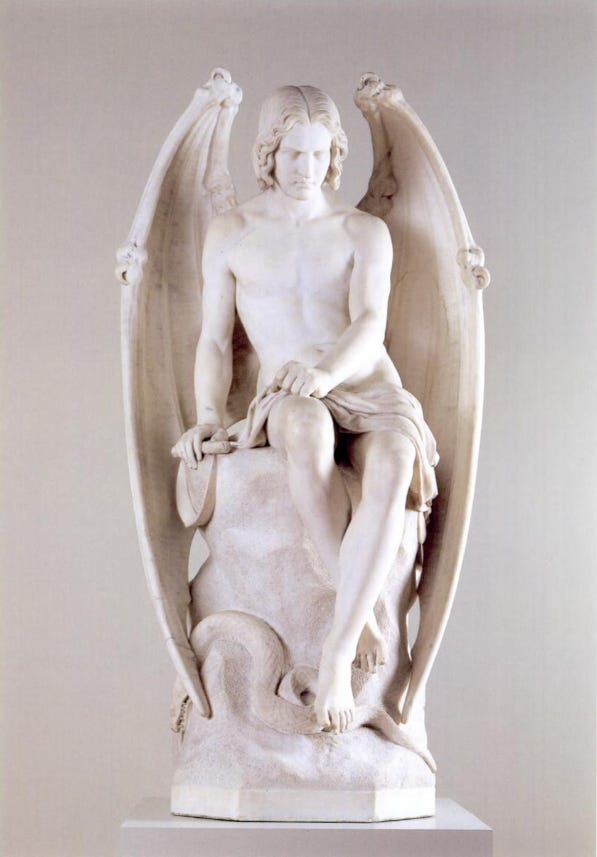
Joseph Geefs, Le’ange du mal. Marble. 168.5 x 86 x 65.5cm. Currently held in the Musées royaux des Beaux-Arts de Belgique, Brussels [catalogue entry]. Photo from De Geest, Joost, 500 chefs-d'oeuvre de l'art belge (Lannoo Uitgeverij, 2006), p203 [here].
Joseph’s L’ange du mal depicts a young male figure atop a rock. Were it not for the serpent and mandorla of bat wings, it hardly appears to depict a traditional image of the Devil. In fact, this was the main cause of concern among the church administration: it did not represent a Christian ideal and was inappropriate to its setting. It was too sexual, too alluring to young, sensitive girls (or in fact, the clergy!)… in short:
Ce diable-là est trop sublime
This devil is too sublime
L’Émancipation, 4 August 1844, as cited by Jacques Van Lennep, La sculpture belge au 19ème siècle : [exposition, générale de Banque, Bruxelles, 5 octobre-15 décembre 1990] (1990)

And it’s not hard to see why. Joseph’s figure is almost androgynous, with a slim, curved body and daintily crossed ankles. His knees rest slightly open, seductively so, and his upper torso, arms, and legs are fully nude. He is clad only in a cloth that drapes over his lap. His face is soft, eyes cast downward, with hair that reaches his nape.
And so, very soon after its installation, Bishop van Bommel ordered Joseph’s sculpture to be removed. In its place, the building committee commissioned his brother Guillaume to create a second version of Lucifer, and this time, with less sex appeal.
Guillaume’s replacement
The building committee passed Guillaume designed the whole set of statues again. On the public-facing end of the pulpit, statues of Saints Peter, Paul, and Hubert, as well as the first Bishop of Liège: Lambert of Maastricht, were to occupy the niches:
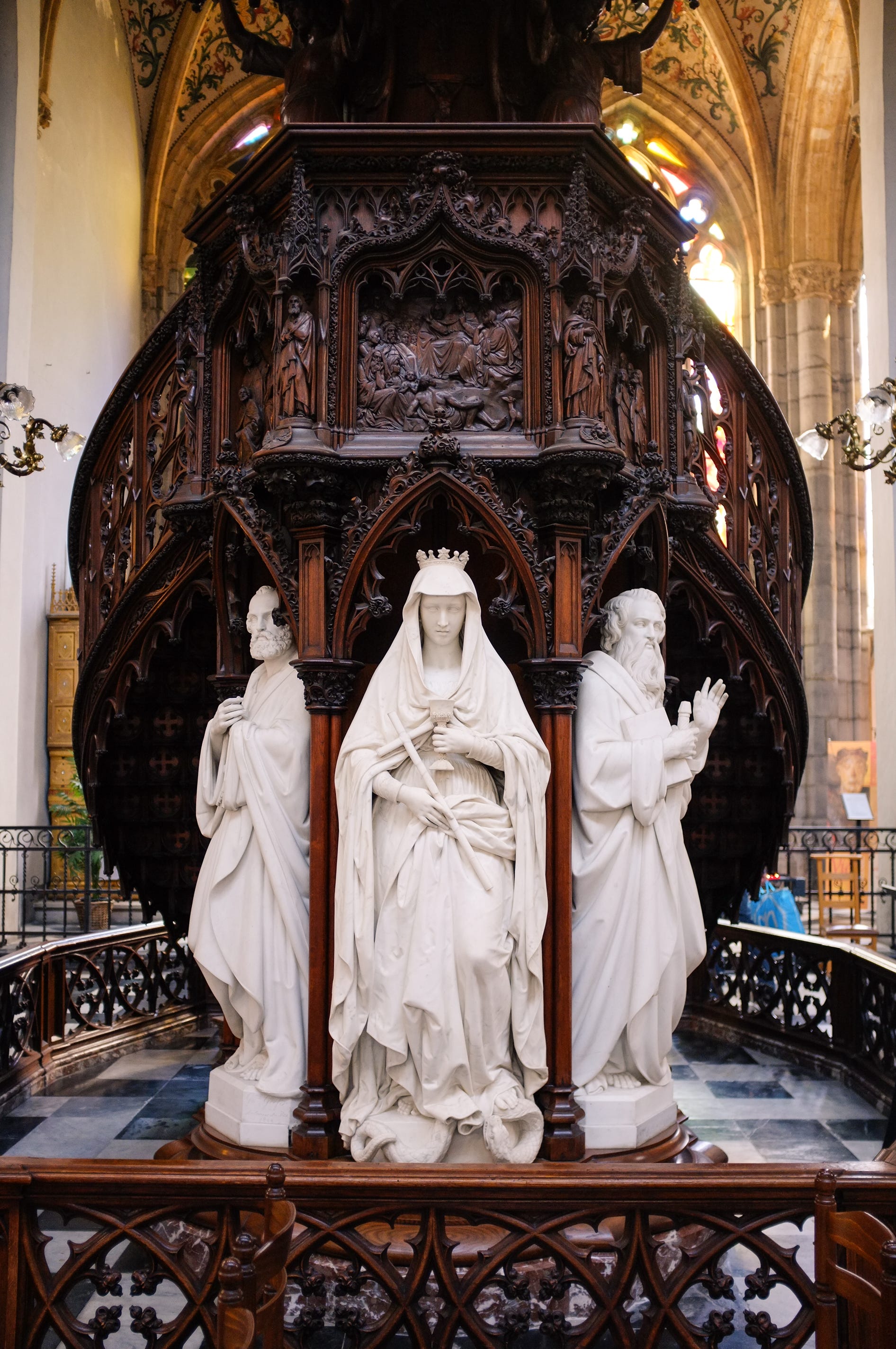
Guillame’s statues in the niches on the public-facing side of the pulpit [ref].
![ref]](https://upload.wikimedia.org/wikipedia/commons/e/e2/Li%C3%A8ge%2C_Belgium_%2818168976081%29.jpg)
And in the same space as Joseph’s sculpture went Guillaume’s new creation: his Le génie du mal. Let’s take a look:
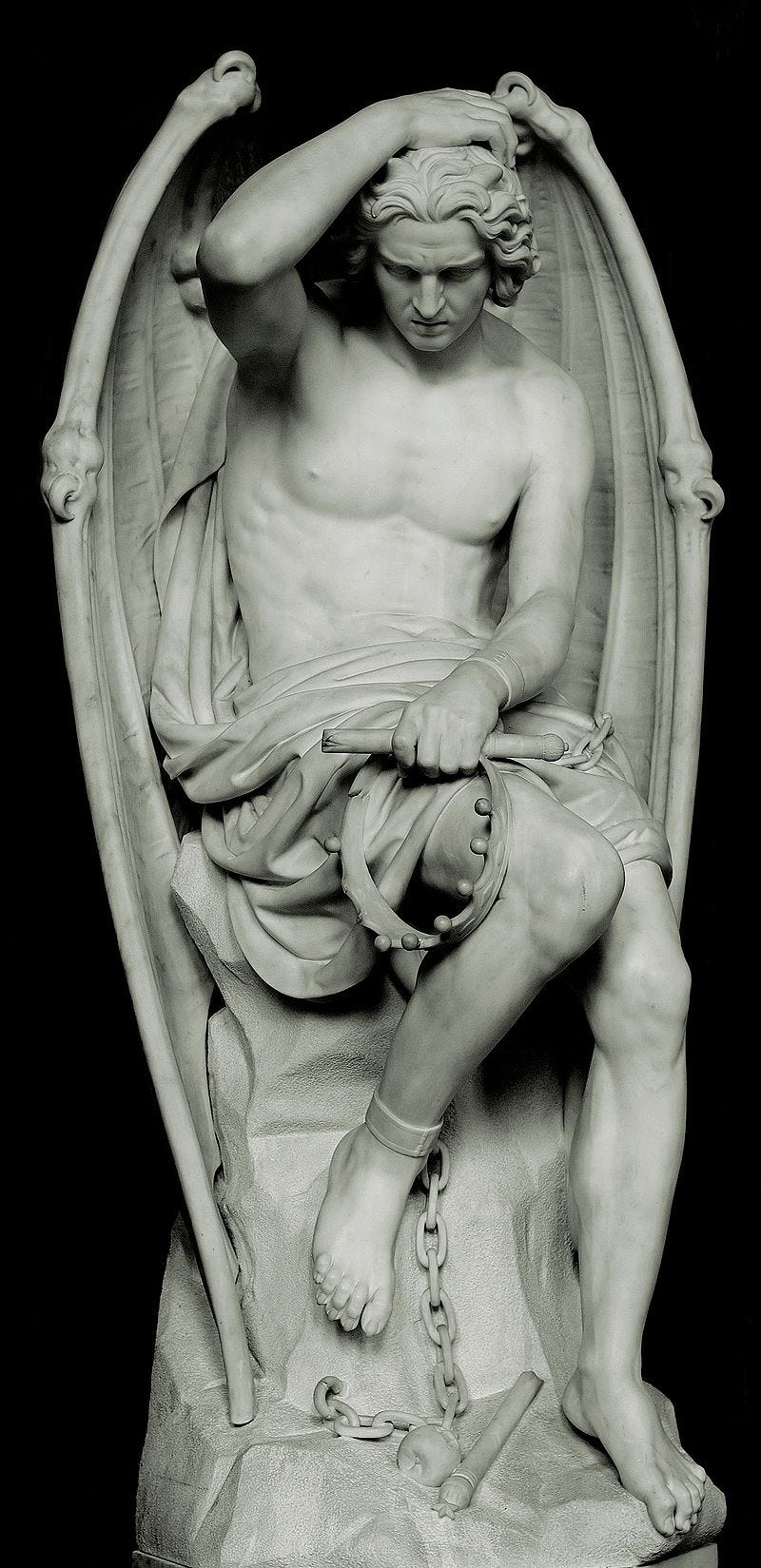
Guillaume Geefs, Le genie du mal. Marble. 165 x 77 x 65 cm. [ref]

At first glance, Guillaume’s version of the statue is strikingly similar to his brother’s. It too couples realism with Neoclassical restraint, namely in the combination of human and bat anatomy. Its figure is scantily clothed, sat on a rock (chained this time), and his gaze is cast downward. But now we see the changes: his body is more stereotypically masculine, still curved but more muscular, broader and better defined. His positioning is different: an arm is raised and its hand grips his hair - this is more voluminous too. A broken sceptre and simple crown are held at his right hip. The serpent at his feet has been replaced by an apple - a nod to original sin. And finally, a single tear falls from his left eye.
It was installed into the cathedral permanently in 1848, without complain. But is it really a more sexually subdued iteration of his brother’s Lucifer portrait? Or is it… unwittingly… sexier?
I’ll leave that for you to decide. But either way, I find it interesting that Guillaume’s statue was accepted where his brother’s was not. Why? Was it due to the androgeny of Joseph’s version? Its openness? Or something else? Let me know what you think down below.
Yes, the second Lucifer is much more masculine and women on the whole like masculine men. He is also beautiful, and the hand in he hair and the broken crown hint of repentance. Definitely much more attractive to girls!
I would say the second is more attractive to women, being more masculine. The first is more effeminate, being more attractive to gay men.
But can I just give a nod to whoever made the staircase. That wood work is amazing. I can't imagine what the process is for making something like that.