


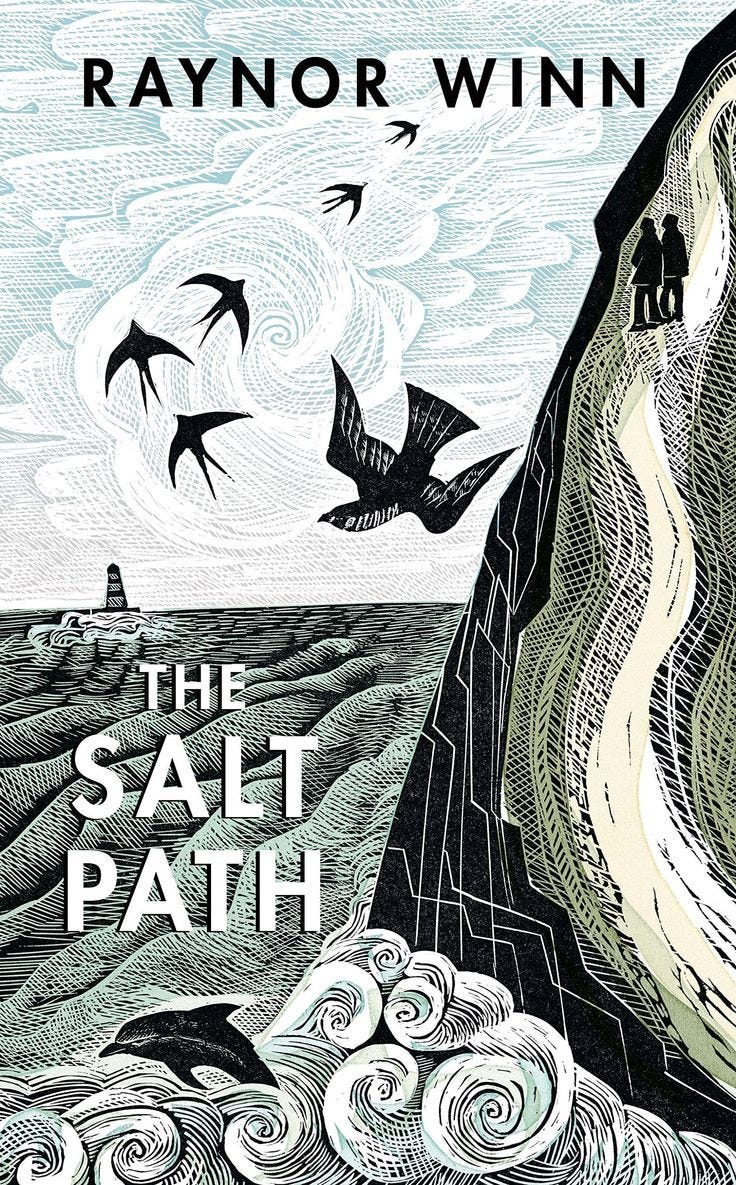
Hi all, and welcome back to rumblewrites. I apologise if this is yet another in a series of articles on the The Salt Path controversy that have made their way into your inbox this week. I’m sure many of you have been inundated. Or at least made aware. But in case you’ve missed it, or want to read my opinion on the matter, do carry on. Because today I’ll be talking about The Salt Path, a memoir by Raynor Winn, and the recent controversy kicked up around its authenticity by The Observer.
Plot summary
I feel the need to put this disclaimed right up front: I have not read The Salt Path. Nor have I seen its new film adaptation starring Gillian Anderson and Jason Isaacs. But I do know what it’s about (thanks to several long discussions at my book club), and I’m well aware of its popularity. It’s been sat on the first table of every Waterstones and Foyles I’ve stepped foot in over the past couple of months. And it’s been sat on my TBR for even longer. But for anyone who it’s aware, this is the plot:
Raynor Winn and her husband, known as Moth in the book, lose a large sum of money in a failed investment. As a result, they lose their house. Moth has recently been diagnosed with corticobasal degeneration (CBD), a fatal illness with acute physical symptoms. With nowhere left to turn, the pair decide to walk. And they embark on an epic 630-mile voyage by foot along the South West Coast Path in England.
Billed as a memoir, The Salt Path is by all accounts a poignant reflection on homelessness, illness, and human spirit. It has sold over 2 million copies since its publication in 2018, and has since sparked 2 sequel novels. These have been published under Winn’s contact with Penguin.
The accusations
However, the truth behind this account of hardship has recently been called into question. On 5th July 2025, The Observer published an exposé piece entitled: ‘The real Salt Path: how a blockbuster book and film were spun from lies, deceit and desperation’. Researched and written by investigative journalist Chloe Hadjimatheou, the article details the apparent extent of Winn’s lies. In her book, Winn - real name Sally Walker - describes her and her husband’s unfortunate circumstances as a result of misplaced trust. They invested a hefty sum into a friend’s business, which then went bust. They subsequently lost a court case to get that money back, and their house was repossessed. However, according to their old friend and co-worker Ros Hemmings, Walter in fact embezzled “around £64,000” from her husband’s estate agency over the course of several years while working as his bookkeeper. Walker was arrested, but never showed up to court. Several other individuals were interviewed in relation to Walker’s finances, and also claimed she owed them money.
Hadjimatheou’s report also references documents evidencing the Walkers’ purchase of a house in France in 2007, which it appears they still own. And still owed property tax for. This investigation therefore not only calls into question the circumstances under which the Walkers lost their money, but also their “homeless” status altogether.
Furthermore, the article also questions the legitimacy of Tim Walker’s CBD diagnosis. While I don’t think it’s necessarily right to speculate on other people’s medical history, I will explain the reasoning here: Hadjimatheou spoke to 9 neurologists and researchers specialising in CBD, all of whom expressed scepticism about Tim’s illness. Michele Hu, a Professor of clinical neurosciences at Oxford University, explained the reason: “I’ve never looked after anyone that’s lived that long”. While much about the illness is unknown, and its manifestation can be variable, the average life expectancy for someone with CBD is around 6 to 8 years from when their symptoms start [ref]. Tim has lived with his CBD for 18 years now, with seemingly no visible acute symptoms. This is highly unusual, as is his apparent ability to reverse them. Across all her books, Walker claims that their long treks through the country massively improve Tim’s symptoms, a method of treatment which, at the time of writing, has no scientific backing.
So what?
Walker has called the claims in The Observer report to be “highly misleading” and has not issued any further statement as she is pursuing legal action [ref]. When asked for a statement, Penguin simply said that it did its “due diligence” when they published The Salt Path [ref].
It’s worth remembering that we do not know these people. We have never met Sally or Tim Walker, Ros Hemmings, Chloe Hadjimatheou, or anyone involved in this story. We also have not seen any of the interview transcripts, reports, or documents referenced in The Observer’s article. And while The Observer does mostly produce well-researched, accurate articles, like all news reports, they are not immune to error. It would therefore do to retain a healthy dose of scepticism in this matter.
With that being said, the report does appear to be pretty damning. And for the rest of this article, I will act as though they are true.
So what if they are? What’s the big deal? So The Salt Path may not be the “unflinchingly honest” and “true” story described by Penguin (at time of writing), but it is still a moving story of love and hardship, in which many have found comfort. It’s even inspired readers to undertake similar walks. So what if it’s fiction? Here’s what:
It was sold under false pretences. The Salt Path was marketed to the world as a memoir, and thus its readers were expecting unflinching honesty promised by Penguin. This may not only cause legal problems, but also moral, in terms of misrepresentation. It breaks the reader’s trust in the author, and potentially the publishing house too (although let’s be real: Penguin is too big to be knocked down by this).
A book focusing on chronic illness carries a heavier burden than most. Especially when that book seemingly offers an alternative treatment plan, and suggests that CBD can be “cured” or at least dramatically improved by something as simple as walking. While there is still so much unknown about CBD, it is a degenerative disorder, and one which is often placed under the braket of pallitative care. Presenting the illness in this way could cause real-life rifts for those who decided to follow alternative treatment paths based on the “truth” presented in this book.
It steals the voice from disabled and chronically ill writers. Instead of Penguin’s publishing deal going to an authentic voice, it went to Walker. She appropriated the story and struggle of a group to which she has no claim, and benefited (massively) from it. This also depletes public trust in disabled and chronically ill writers in general - it is exactly why they struggle so hard to be taken seriously.
This is a huge controversy in the writing world, and one which I’m interested to see unfurl. If any major developments occur over the coming months, I may write an upgrade to this article. But for now, this is my piece on the matter. What are your thoughts?
I was just hearing about this the other day! It’s definitely a bad look, though I agree we should all be skeptical of things we read online. If it’s all true, I wonder why they thought they could get away with this when there’s so much evidence against them 🤔
(Very well written piece, by the way. You balanced journalism and your own opinion very well!)