


Hi all, and welcome back to rumblewrites. This week’s post is another book review, this time of the Margaret Atwood’s Alias Grace.
If you enjoy this article, you can check out my other reviews here, and subscribe for more:
Alias Grace is a near-500-page fictional account of the real-life Grace Marks, a young Irish emigrant who came over to Canada in the early 1800s. She worked as a servant throughout her childhood and, at age 15, was tried for the murders of her master Thomas Kinnear and his housekeeper Nancy Montgomery. James McDermott, her so-called co-conspirator, was sentenced to hang for his involvement in the crime. Grace, on the other hand, was given life imprisonment - a lesser sentence due to her youth and supposed half-wittedness.
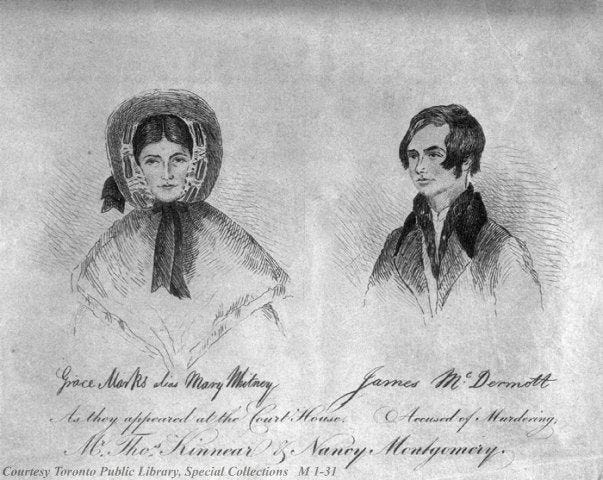
From the Trial Pamphlet, (1843) Grace Marks (left) sketched with James McDermott (right). Source: Wikipedia

Although the book is based on real events, Atwood also invents situations and characters to aid her storytelling, namely the doctors Simon Jordan and "Neuro-Hypnotist" DuPont. Grace’s personal history is primarily told through her interviews with Dr Jordan, who is researching the mental faculties and behaviours of criminals. Through these interviews, Atwood presents the crime in much the same way as it was back in 1843: through the lens of female seduction, murder, and malady. But she does not attempt to answer the question at its core - whether Grace committed it; rather, she focuses on the character of Grace herself and the validity of the accusations levied against her by a patriarchal society and medical system.
Having read some of the reviews on Goodreads, it seems some of the lower ratings were attributed to the book’s unsatisfying conclusion. But I think this reaction misses the point. As an historian by training and an archivist by trade, I for one am very comfortable in not knowing. The stories we glean from the past must be based in truth - it is not worth our while to guess - but it also cannot escape out attention that this truth is subjective. This is what Atwood is trying to show us: that there is no such thing as absolute truth. There are individuals and their experiences, and there are the stories attached to them by others. As Grace herself says:
He doesn't understand yet that guilt comes to you not from the things you've done, but from the things that others have done to you.
It doesn’t matter whether or not Grace committed the crime, what matters is that others think she has. Because this ostenciably means that she did.

As Dr Jordan is reviewing the circumstances surrounding Grace’s incarceration, the question of her sanity and the validity of her sentencing is raised. Can someone be to blame if they are indeed half-witted? Or if they claim not to remember the crime? Or if their body is taken over by the spirit of their dead friend? Regardless of my personal response to these questions, they become more interesting when viewed in the light of gender.
Atwood is no stranger to the science, both medical and mystic, that was used to diagnose and treat those with mental illnesses in the early 19th century. I have written an article on this myself, in fact, so I won’t tread over old ground. All I’ll say is that Grace well understood the difficulty of refuting the label “murderess” once it had been attached to her:
If I am good enough and quiet enough, perhaps after all they will let me go; but it’s not easy being quiet and good, it’s like hanging on to the edge of a bridge when you’ve already fallen over; you don’t seem to be moving, just dangling there, and yet it is taking all your strength.
The doctors clearly believe Grace to be an hysteric. A girl rendered victim to her emotions. In the early 19th century, hysteria was a uniquely female disorder, and one which was often brought on by circumstance. Of course, it was often placed over real cases of post-partum depression, anxiety, bipolar disorder, etc. But it was also attached to those women who did not fit the social norm. Divorcées. Mothers. Individuals. And it was even sought-after - as a means of escaping financial ruin, domestic abuse, or any other manner of social ills. That is to say: in all cases, hysteria was a woman’s burden, and it was a diagnosis levied at those deemed undesirable to occupy a space in society.
Grace is, therefore, a victim of sorts. She is at the mercy of social expectation and prevalent (although incorrect) ideas about mental health in women. She is not only at the mercy of public opinion, but also of the medics themselves, whose misguided approach has the power both to liberate and to condemn her.
The final point I’d like to touch on is that of female sexuality, which is often wound up with ideas about the female mind (with regards to hysteria and one’s inclination to crime). Grace is treated abusively by both the male and female adults in her life, but it is a particular kind of sexual abuse that is levied at her by men:
For God's sake, shut your mouth, you slut. You stupid whore.
McDermott says. These put downs come in response to her talking, having an opinion, having autonomy. When she refuses to sleep with him, she is a whore. When she talks to another man, you guessed it: a whore. No matter what Grace does, any behaviour that the qualifying man doesn’t agree with earns her this label. Of course there is the frequently-made point about female “whores” really being victims of rape or abuse, and about the fact that the men calling them that are often more whorish themselves. But I want to touch on another point here: Grace’s degradation to a seductress. She, at age 15 and earlier, is accused of seducing McDermott into carrying out her evil will. This is clearly preposterous, but Atwood doesn’t actually exclude it as a possibility - she lets us sit in this ambiguity, and in doing so calls attention to the same line of argument which is unfortunately still used today. That our Lolitas bend our Humberts to their wills through expressions of sexuality, and that it is them, not the men, who are thus to blame.
It is no wonder, then, in such a world that Grace had thoughts of violence.
If we were all on trial for our thoughts, we would all be hanged.
But these thoughts and their accompanying emotions are transitory - dire circumstances do not necessarily lead to crime, nor can they be to blame for it. [I sense a backlash against this, oops]. By placing so much impetus on women’s moods and expressions attribute actions to them which they would not dream of committing. And which men, in fact, do commit, every day.
This article has turned into more of a response than a review, but all in all, I thoroughly enjoyed Alias Grace. I was a little worried about the length of it - I always try to mix up my reading and I fear I’ll DNF if I’m stuck in the same time, place, and body for too long. But I knew I liked Atwood - Hairball, Hagseed and The Handmaid’s Tale already being among my favourites - so I thought I’d give it a go. And I’m so glad I did! As always, Atwood’s writing is well-researched, evocative and holds a subtle power. She has a real talent for storytelling. So yes, Alias Grace was most certainly a 5 star read which I would highly recommend to you all.
Have you read Alias Grace? Which Atwood novel should I try next?
I hadn’t heard of this book but will definitely give it a go. Your paragraph about hysteria really caught my attention. I’ve just finished a dissertation about divorce and shame in late 19th century and it was remarkable how many times women’s mental health was discussed with derision and attributed to hysteria.
“He doesn’t understand yet that guilt comes to you not from the things you’ve done, but from the things that others have done to you.”
If we were all on trial for our thoughts, as Lucy notes, the gallows would never be empty. SUCH a great read. 🖤