


Hi all, and welcome back to rumblewrites. This post is another #onthisday historical deep-dive, and it’s another look at Napoleon’s Italian Campaign. If you enjoy this article, you can check out my previous historical posts here, or subscribe for more:
How did we get here?
The Battle of Rivoli follows on almost directly from the events outlined in my post about the Battle of Arcola (15th November 1796). Check out that article for a full run down, as well as for some background context and recommended reading.
Battle of Rivoli
The following January, Alvinczi made his 4th and final attempt to relieve the siege of Mantua. On 13th, he marched a 28,000 strong Austrian army towards Rivoli. When night fell, he decided to set up camp on the southern slopes of Monte Baldo. It was clear to Napoleon that this force would constitute the main Austrian attack, so he sent some of his men to drive them further toward Rivoli, while he rode ahead to survey the battleground.
The battle itself began at 7am the following morning. At this time, Napoleon’s forces were badly outnumbered, set at c.10,000 under General Joubert compared to Alvinczy’s 28,000. However, Alvinczy’s convoluted plan of attack meant that only 12,000 of his men would be involved in the first stage of fighting. He had decided to split the Austrian army into 6 columns with the aim of surrounding and enveloping the smaller French army. But this plan effectively reduced the Austrian advantage in numbers and, as fate would have it, meant that around half of the remaining troops never participated in most, if not all, of the battle!
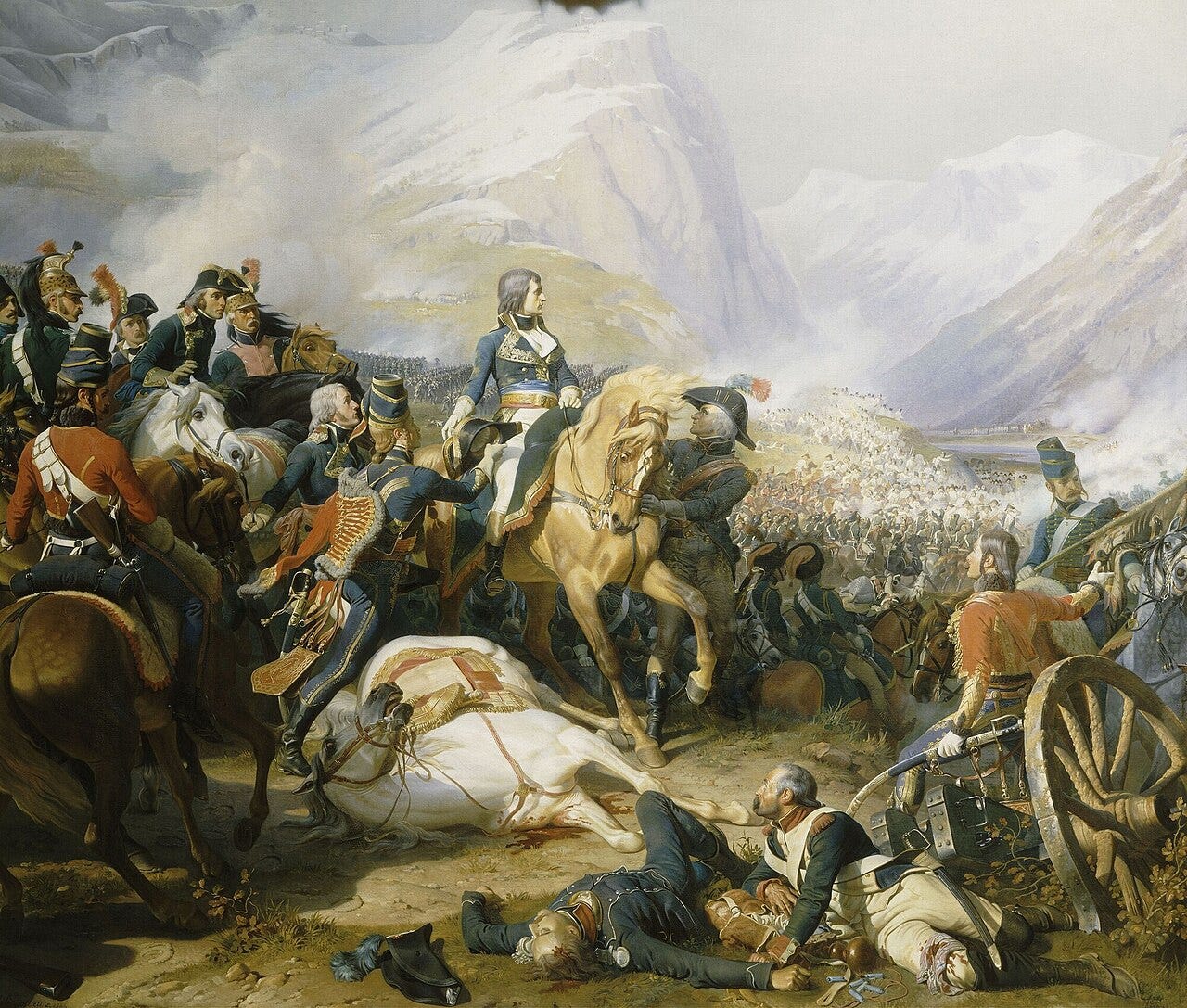
Henri Félix Emmanuel Philippoteaux, ‘Napoleon at the Battle of Rivoli’ (1844)
The last Austrian attack came at 11am, when another of Alvinczy’s 6 columns finally made its way onto the battlefield (lol). Technically, the Austrian troops now had Napoleon surrounded, but his defeat of one of the columns and the opportune arrival of more French forces under Masséna meant that he was well-placed to deal with this new threat. Seeing this, another Austrian column surrendered. This forced Alvinczy to order his remaining divisions to retreat.
They fled back north towards La Corona, but Napoleon sent Joubert after them the following day. By 16th January, around 15,000 Austrians had been taken prisoner! Only c.13,000 remained and escaped with Alvinczy. And Napoleon could have followed them too, if he hadn’t needed to leave for Mantua that same evening. It was a decisive victory.
By the end of March 1797, Mantua had fallen and Napolen was marching on Vienna. The commander of the Austria troops called for a truce. This culminated in the pair signing a peace treaty at Campo Formio in October that year, a document which was negotiated by Napoleon himself.
Significance
The Battle of Rivoli was the climactic event of Napoleon’s 1796-97 Italian campaign. It led to the Austrian surrender of Mantua, the consolidation of French power in northern Italy, and ultimately France’s victory over the Austrian forces later that year. It also demonstrated Napoleon’s proficiency as a military leader. The Italian Campaign established him as an inspirational military figure, particularly due to the care he gave his men, the effectiveness of his pillaging, and his military tactics.